Have you had your Epiphany Wine Moment?

How a fabulous bottle of wine can change your life…

As featured in Wine Enthusiast

For those of you who have already basked in your epiphany wine experience, allow me to congratulate you. And if you are not sure if you have had it or not, then it most definitely has not happened, as it is unmistakably crystal clear when it does occur. The beauty of the epiphany wine moment is that you never know when that illuminating discovery of the senses will come and knock you off your feet.

My moment came early on in my wine journey, and as it happens would end up leading me into wine as a career. I was living in New York City and going to school for my Master’s in Education while working to put myself through school. I had always been interested in, and enjoyed, wine as part of our Sunday Italian family dinner ritual at my grandparents’ house. Of course, it was usually baskets of Chianti on the table, but on special occasions my grandpa would bust out a bottle of somewhat generic Burgundy—comparatively it was a real treat.

California reds were next; and, boy, were those wines eye opening. All that fruit, oak and alcohol opened a whole new world of flavors and textures. But they still didn’t provide my “holy crap, is this wine phenomenal” moment. That happened at Sparks Steak House in Manhattan where my family was celebrating my dad’s birthday. He was feeling saucy that night and splurged for a bottle of 1986 Premier Cru Gevrey-Chambertin, which at that point was about 10 years old.

I swirled; I smelled; I sipped. Then I think I passed out for several seconds. But when I came to, the berry fruit flavors combined with the black pepper spice, floral notes and earthy, mushroom undertones lingered unlike anything I had experienced before. And the unwavering creamy texture on the palate is something I have yet to experience again. It literally left me speechless for about a minute, but once I came to and started raving about it, I haven’t stopped since.

What is this epiphany experience though? It can be an ethereal sniff and sip of wine that mystically opens all your senses to how an incredible wine can smell and taste. All those wine descriptors that you may have heard in the past that probably sounded a little wacky, start to have meaning. The crushed rose petals, the grilled bing cherry, the delicate and harmonious balance of searing acidity and sleek, silky tannins. It’s astonishing when a wine can turn on that sensory light bulb in your head. It’s downright emotional.

It also feeds into the potentially lifelong quest of replicating it. Wine lovers search their whole lives trying to wrap their arms around another epiphany wine experience, but it is easier said than done.

The moment the aha-wine passes your lips it opens your eyes to the intricacies of the universe inside a grape, and you start to question and understand the differences in varietals, regions, terroir, ageing, vintages, winemaking processes and cellaring. It almost forces you into thinking while you’re drinking to decode the mystical experience to determine what you love so much about certain wines and why, and what you don’t enjoy and why not. Yet when it comes to that one wine, the one that lit the fuse, there is no thought on that one. It goes directly on the Janis Joplin theory of enology: “You know you got it, if it makes you feel good.”
Left Bank vs. Right Bank in Bordeaux: What’s the Difference?

As featured in Wine Enthusiast

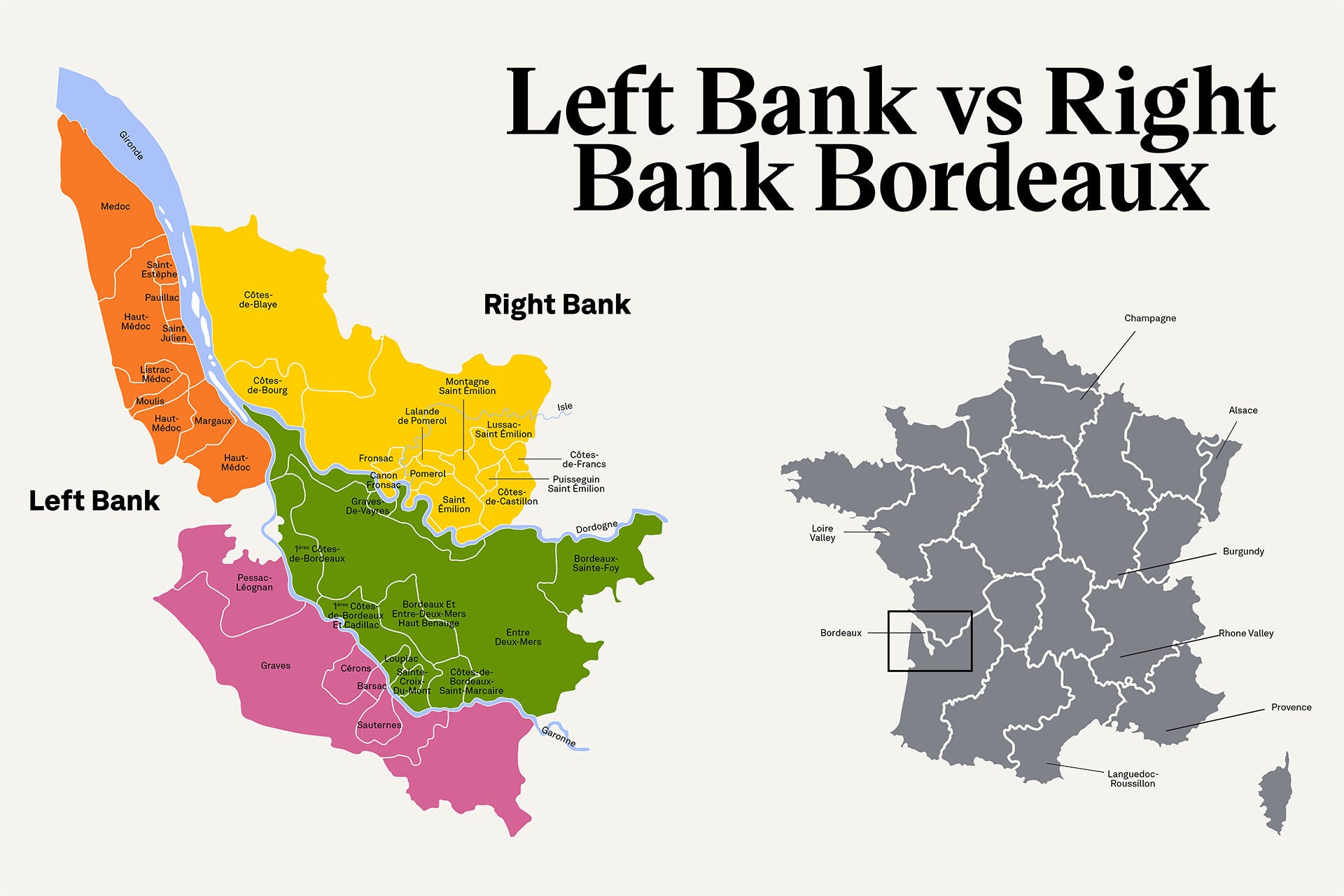
If you have spent time in Bordeaux, France, or chatted with friends over a bottle that hails from the region, the inevitable conversation of Left Bank versus Right Bank wines will arise. Just to clear the air—this debate has nothing to do with cash flow or basketball (as in, bank shots), but everything to do with the river banks in Bordeaux, which correspond with different styles of wines.  

Confused? Fret not. We have demystified the differences between Left Bank and Right Bank wines so you can drink and discuss them confidently.  

What Are the Banks?  

The wine region of Bordeaux is located close to the Atlantic Ocean, giving it a maritime climate. Within Bordeaux lies a body of water, called the Gironde Estuary, that connects the Atlantic Ocean to two rivers. The river that runs along the east side of Bordeaux is called the Dordogne and the river on the west side is called the Garonne. These two rivers connect at the base of the Gironde Estuary and fork outwards.

The wine regions that are located to the east (right) of the Dordogne River are considered part of the Right Bank. The regions that are located between the two rivers and to the west (left) of the Garonne River are called the Left Bank. All of that underwater turmoil where the two rivers connect contributes to differences in soil composition on the two banks, which can create uniquely different wines.  

Bordeaux Appellations to Know 

The two banks have numerous appellations that are well-known for producing exquisite wines. The Left Bank includes the Médoc and Haut Médoc wine regions, which encompass some of the highest-rent districts in the wine world. This is where the most recognized and world-renowned Bordeaux appellations are located, such as Saint-Estèphe, PauillacSaint-Julien and Margaux.  

To the south of the Médoc, but still in the Left Bank, you have Pessac-Léognan and Graves, and then Sauternes and Barsac further south, which are known for their sweet wine production.   

The Right Bank’s most famous appellations are Saint-Émilion and Pomerol, noted for the most age-worthy wines. The area also includes those of Fronsac, Canon Fronsac, Lalande de Pomerol, Côtes de Blaye, Côtes de BourgCôtes de Bordeaux and Castillon Côtes de Bordeaux.   

Left Bank vs Right Bank Bordeaux
WINE ENTHUSIAST

Unique Soils and Terroir  

While only a proverbial stone’s throw away from one another, the soil between the Left and Right Banks vary significantly. Thanks to all that underwater mix-up, which happens when the rivers meet the estuary, the Left Bank’s soil possesses more of a limestone base, but with a gravel layer on top. It has minimal clay to retain moisture, so the vines must go deeper for water. That struggle often leads to more concentrated flavors in the fruit.  

Meanwhile, the Right Bank inherently has that same limestone, but it is closer to the surface. Additionally, clay dominates the soil composition and has far less gravel. Why is that important? Funny you should ask… 

Left and Right Bank Grape Varieties  

Different grape varietals thrive in differing types of soil—and this is especially true when it comes to what thrives in the Left and Right Banks. Cabernet Sauvignon prefers the struggle that the rocky, gravelly soil that the Left Bank offers. The gravel captures and holds heat, helping the area’s wines to develop ripe fruit flavors and those big, chewy tannins. This allows these wines to age for the long haul. Other varietals such as MerlotCabernet FrancPetit Verdot and Malbec play accompanying roles on the Left Bank, but far and away Cabernet Sauvignon is the star and the main grape used in the majority of wines.   

On the Right Bank (the northeast side of the Dordogne) Merlot reigns supreme. It relishes in the extra water that clay tends to hold, and doesn’t require extra heat, as Cabernet Sauvignon does. It is typically blended with Cabernet Franc (certain Chateaux will even use Cabernet Franc as the dominant grape), with Cabernet Sauvignon, Petit Verdot and Malbec making cameo appearances in certain wines.

Different Wine Styles  

So, with all the varying soils, terroir, grapes and appellations, how do the wines differ in the bottle? The Cabernet Sauvignon-heavy blends from the Left Bank are typically bigger, bolder and more ageable wines. That’s because the higher fruit concentration and tannin levels are conducive to wines that will evolve and improve with time in the cellar.  

In comparison, the Merlot-based blends of the Right Bank tend to be smooth and supple in their youth, with soft fruit and mellow tannins making them ideal for early enjoyment. Of course, the top-tier wines of St. Emilion (from Pavie, Figeac, Clos Fourtet, Angelus and others) and Pomerol (from Petrus and Cheval Blanc) are certainly cut from the same cloth as those ageable Grand Cru Classe wines of the Left Bank and can benefit from decades in the cellar. 

Classifications  

The Left Bank is also home to the notorious 1855 Classification of the Médoc, which includes the five “first-growth” estates of Château Margaux, Château Mouton Rothschild, Château Lafite Rothschild, Château Latour and Château Haut-Brion. (Although Château Haut-Brion is technically in Graves, not Medoc.)  

Beyond this exclusive first growth club, there are 14 second-growth estates, 14 third-growth, 10 fourth-growth and 18 fifth-growth. The area’s Sauternes and Barsac sweet wine producers also have their own classification system. 

The only classification in the right bank is that of St-Emilion. It originated in 1955, and wines are tasted, reviewed and updated every 10 years. The top-tier wines receive the Premier Grand Cru Classé designation, which are further distinguished by “A” and “B” rankings. The latest 2022 edition includes 14 Premier Grand Cru Classés, with only two (Chateau Figeac and Chateau Pavie) awarded Grand Cru Classé A status, and 71 Grand Cru Classés.   

Not too complicated, we hope? Armed with this knowledge, drinking your way through Bordeaux has never been easier.